Prototype materials

Public prototype materials for technical review.

This page brings together the current public prototype materials for GIFTS. They are meant to show implementation structure, evaluation logic, and technical maturity without exposing restricted systems or data.

Public package contents

Currently available

  • prototype report describing structure and evaluation framing
  • reference code entry point for direct technical inspection
  • public materials that show the current implementation package
  • supporting artifacts that help readers inspect the work

Not included here

  • proprietary employer systems
  • restricted operational data
  • customer information
  • confidential internal implementation details
How to review the prototype

Start with the report, then choose either code inspection or package download.

For most readers, the report PDF is the best starting point because it explains the prototype structure and evaluation framing. The public materials now support two follow-up paths: quick code inspection and a fuller reference-package download for local evaluation.

Prototype report PDF

Best first stop for understanding the prototype structure, mechanics, and evaluation framing.

Reference package download

Best option for readers who want the full runnable public reference package rather than a single entry-point file. The bundle includes input and output contracts, a CloudTrail-like adaptation example, and sample output artifacts from a small reference run.

Prototype entry point

Best follow-up for readers who want to inspect the reference implementation directly.

Current release status

The public package is a reviewable reference implementation.

GIFTS is currently presented as a downloadable reference package for technical evaluation. It shows the model structure, synthetic evaluation flow, forensic-style outputs, and the public input and output contracts needed for review and adaptation. It should be read as a serious reference implementation, not yet as a finished enterprise product.

Useful today

  • technical review and code inspection
  • local execution of the public prototype pipeline
  • evaluation of model flow and report outputs
  • adaptation by technically capable collaborators

Still ahead

  • stable third-party ingestion adapters
  • production deployment workflows
  • operator-facing interfaces
  • release-grade integration documentation
End-to-end walkthrough

Follow one public path from raw events to workflow findings.

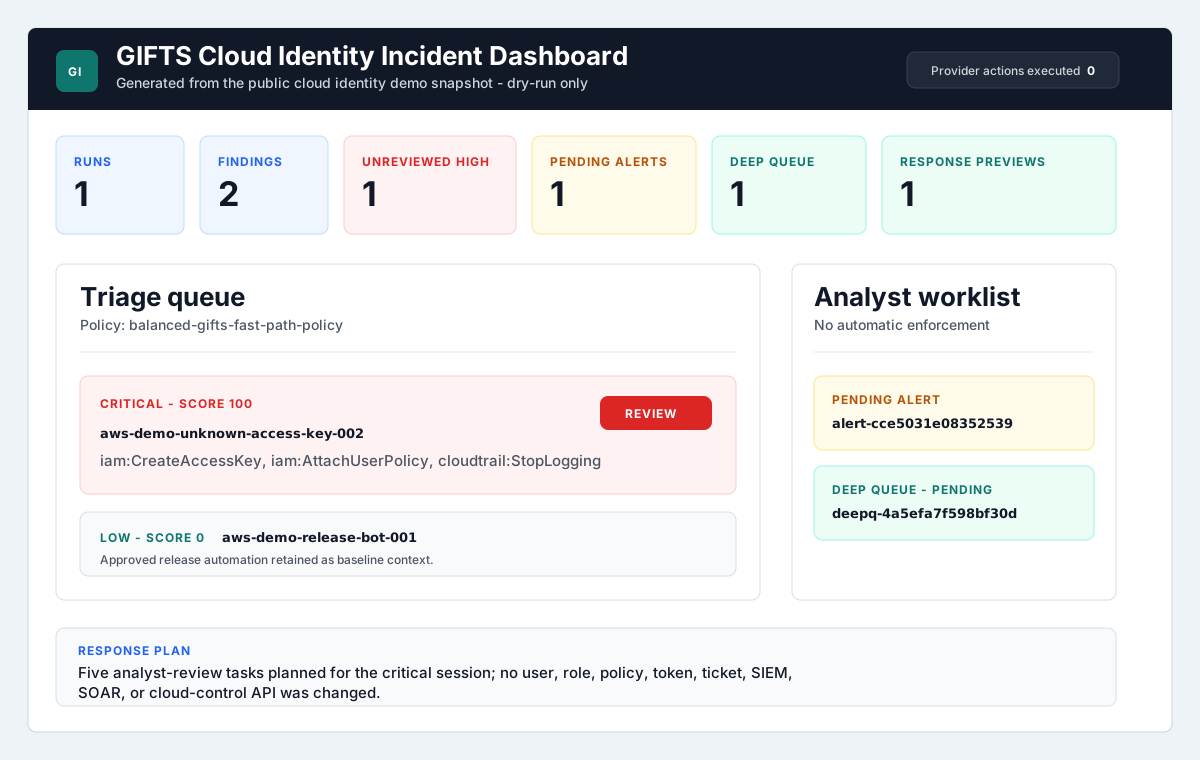
This short walkthrough shows the current public adoption path in sequence: start from CloudTrail-like raw records, convert them into the GIFTS session contract, score the sessions into analyst findings, then inspect the structured outputs from a small reference run.

Step 1. Raw event input

Begin with session-tagged CloudTrail-like records that preserve action name, source, principal identity, IP, region, user agent, and resource context.

Step 2. GIFTS session contract

Convert those records into the stable sessionized GIFTS contract. That is the current public handoff between provider-specific logs and the reference package.

Step 4. Structured model-run outputs

A small reference run can emit both a human-readable forensic report and a machine-readable JSON summary for comparison and downstream review.

How to read the suspicious session

In the sample output, the suspicious session includes a blackout interval where events are intentionally hidden. GIFTS now has two public review layers: a workflow scoring layer that ranks the session for analyst review, and a prototype reconstruction layer that can produce multiple candidate reconstructions, a recommended consensus sequence, and per-slot uncertainty values.

  • Workflow findings show which sessions should be reviewed first and why.
  • Observed actions show what the model was allowed to see.
  • Consensus missing actions show the current recommended reconstruction.
  • Uncertainty by index shows where competing hypotheses agree less strongly.
  • Fast-path and deep-path metrics summarize how the small reference run behaved overall.

This is still prototype evaluation output, not a production forensic claim. The goal is to make the current method reviewable, interpretable, and easier to adapt.

Release note

These materials are a reviewable reference implementation, not a production release.

The current prototype demonstrates mechanics, structure, and evaluation logic through public materials. It is best read as a technical reference package rather than as a claim about production scale or enterprise deployment.

Questions about the prototype

Use the contact page for questions about the package, reproducibility, or collaboration.

The contact page is the best route for technical questions, clarification requests, or collaboration inquiries related to the public materials.